Caliban in the Modern Era
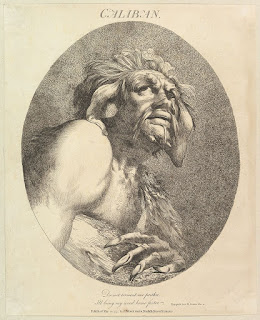
One of Shakespeare’s most mysterious characters, Caliban from The Tempest is the indigenous ruler of the island over which Prospero has assumed control. Caliban is a “monster,” (II.2) neither all man nor all fish––essentially, he is both indigenous and mixed race. In addition to the undefinable nature of his physicality, Caliban’s portrayal is an enigma and has been considered both an instance of pride for indigenous culture and a narrative that dehumanizes and degrades indigenous peoples.
In the modern era, Caliban has adopted a new significance as a symbol of native resistance to colonialism and the preservation of indigenous culture. Though submissive to the white Propsero, Caliban speaks to him indignantly, “curse[s]” (I.2) him, grumbles while completing tasks, and plots with Stephano and Trinculo to overthrow and kill Prospero. Caliban's aversion to completing his forced tasks to Prospero can be interpreted as everyday laziness, perhaps even sloth––one of the Seven Deadly Sins––or as a profound understanding of the injustice of his position as inferior to Prospero.
Caliban also asserts his own ownership of his home, when he says “This island's mine, by Sycorax my mother,/Which thou takest from me.” (I.2) His right to rule the island legitimized by inheritance, and Prospero, on his arrival, “t[ook]” (I.2) the island by force. Caliban also narrates Propsero’s process of colonization over the island––at first, Prospero cared for Caliban and “t[aught]” (I.2) him the English language and astronomy. Prospero’s care of Caliban resembles the ‘civilized mission’ and salvationist rhetoric which Europeans used to justify their colonization of indigenous lands. Then, Caliban lost Prospero’s favor and Prospero used his magical powers to “[en]slave” (I.2) Caliban. Prospero justifies this enslavement by blaming Caliban’s character, his action of “seek[ing] to violate/The honor of” (I.2) Miranda demonstrating Caliban’s natural tendency for lust––another of the Seven Deadly Sins. Caliban concedes that he had attempted to engage in sex with Miranda, but the text does not indicate whether Caliban had raped Miranda or Prospero had found the two consensually ready to have sex when he felt so protective of Miranda as to use force against a would-be innocent Caliban.
In strict adherence to Shakespeare’s text, Caliban enjoys not a flattering portrayal, but rather that of a “savage” (I.2), similar to that white colonists assigned to indigenous peoples to justify colonization. In response to Stephano and Trinculo’s liquor, Caliban “swear[s] [him]self…[the] subject” (II.2) of, essentially in voluntary submission to, Stephano. His addiction to liquor, which comes from Europe, suggests a view of indigenous people in need and appreciation of European products. Caliban’s drunkenness paints a picture of indigenous people as indulgent and gluttonous––a third of the Seven Deadly Sins. However, Caliban’s drunkenness also serves a simple purpose, that of a comic relief from a dark and twisted story.
Shakespeare, in creating Caliban’s character, could not have understood the modern lense through which to analyze his work––but his portrayal of Caliban remains one of the most significant early instance of a European playwright describing an indigenous figure in great detail, with both virtues and vices.
© 2019 by The Green-Eyed Blogger
© 2019 by The Green-Eyed Blogger

photo credit: Metropolitan Museum of Art


Comments
Post a Comment
All comments are moderated by the Green-Eyed Blogger to avoid spam. If you do not see your comment right away, do not worry; it is simply undergoing our routine moderation process.